Last week, Edmonton hit a tragic milestone of 31 traffic deaths in 2025. That is 31 Edmontonians who woke up in the morning and left their house, not knowing they would never make a return trip. 31 Edmontonians who will not come home to their families. This is an incredibly difficult and sensitive subject that has touched the lives of so many Edmontonians over the years, but we can’t shy away from this conversation or sit back and accept these tragedies as inevitable.
So far this year, the vast majority of traffic deaths were preventable with some combination of better enforcement and safer road design. All the fingers seem to be getting pointed at speed enforcement, and traffic enforcement in general. Lack of enforcement is definitely a piece of the puzzle, as speed-related deaths have spiked since the UCP effectively banned photo radar from main roads on April 1, 2025. But enforcement can only get us so far. As a reactive approach to discourage future bad behaviour, it relies on drivers to respect the law and obey the speed limit even when enforcement is not around. If we want to see real progress, we need to implement permanent evidence-based solutions like safer design.
While speeding is a contributing factor to many of the 31 traffic deaths and something we continue to advocate about, it is far from the whole story. Looking at the data, crosswalks, both marked and unmarked, is where vulnerable road users are most in danger. The good news is, we can mitigate risk at crosswalks with safer road and traffic signaling design.
In particular, the fact is left turns are deadly. Of the 31 fatalities in 2025 so far, 13 involved an ill-timed left turn, with many drivers, 4 motorcyclists, 3 micromobility users, and 3 pedestrians caught in the crosshairs. And that is just scraping the surface, as information on how many Edmontonians have been injured and how much property damage has occurred in left turn collisions is not readily available, not to mention near misses.
Why might left turns be an outsized danger in this year’s data? There are a number of factors that play into the riskiness of left turns, such as having to cross oncoming traffic, lots of directional distractions for the brain to process before and during the turn, and the A-pillar blind spot for drivers (the inclined pillar on the side of the windshield).
One thing is for sure, these high numbers are completely unacceptable, but thankfully there are ways we can diminish left turn risks in the built environment.
Our Recommendations
One obvious “quick win” would be only allowing left turns, specifically that cross the path of oncoming traffic with a speed limit of 60km/h or higher at a signalized intersection, during an advanced left signal phase. 7 Edmontonians were killed this year in “left on green” turns that would have been prevented by this recommendation, including 2 pedestrians and 1 cyclist. Many intersections are already equipped with advanced left phases before allowing left turns on solid green, therefore it could be a low cost, high impact project to convert them to advanced left only systems. Dynamic signalling could also be used to ensure traffic flow remains efficient at these intersections.
Another area to consider is how we can better design protection for pedestrians and micromobility users at intersections. Some possible concepts to reduce risks are “refuge islands” in the middle of crosswalks for less exposure while crossing, putting centre line bollards at the edge of the crosswalk facing the intersection to force wider left turns, moving crosswalks slightly further away from intersections to give drivers more time to see and react after turning left (and without other intersection distractions), leading walk/roll signal intervals that give a head start over cars for just a few seconds, raising crosswalks to demonstrate priority, and high-visibility crosswalk markings on the road instead of a thin horizontal strip of white paint. Protections can be applied to fit the context of an intersection, whether it is a quiet neighbourhood intersection or the intersection of two major arterial roads.
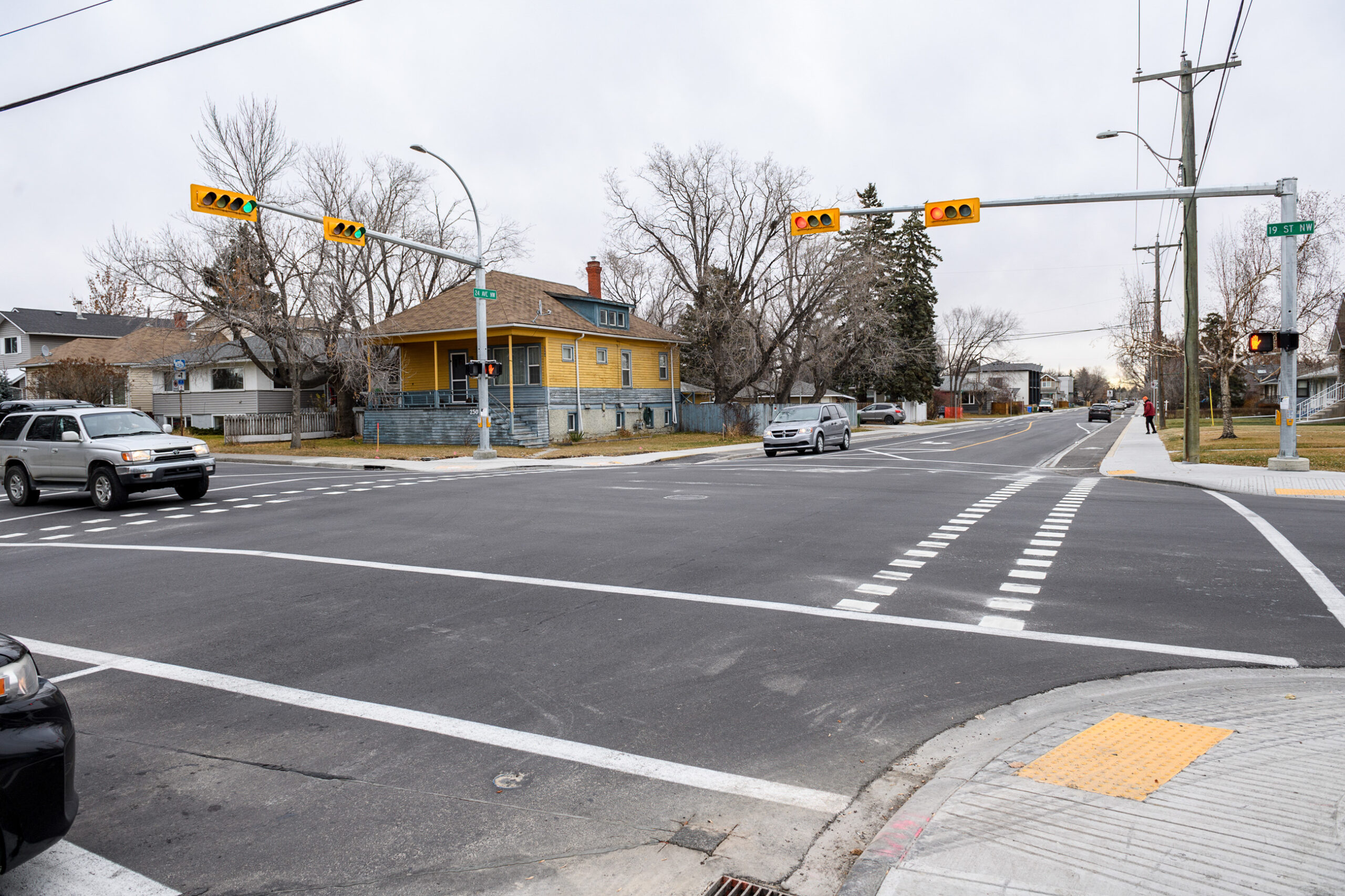
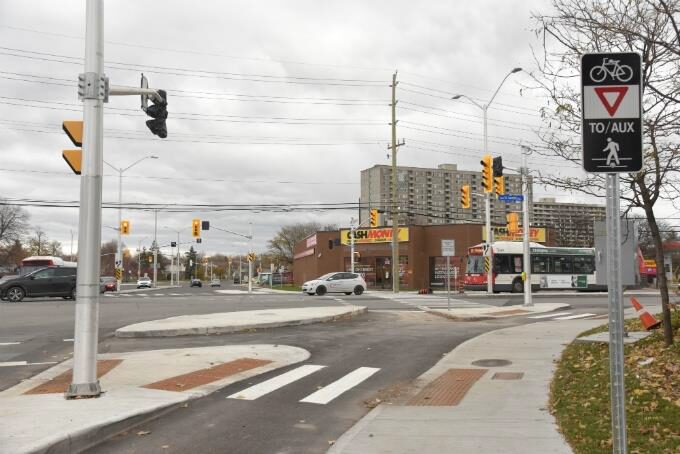
In particular, Shared Pathways present challenges when users cross the road and come into conflict with vehicle traffic. If a driver is unaware that they are turning left (or right) across a Shared Pathway, they will not be expecting to encounter micromobility users travelling faster than a typical pedestrian. Bike lanes are held to a certain design standard to reflect the nature of their use, including green paint, signage and signalling priority. Shared Pathways deserve some sort of design distinction to help drivers recognize their utility. There are some examples close to home, with Calgary’s multi-use crosswalks featuring vertical lines with square markings, and Ottawa starting to build protected intersections where pedestrians and micromobility users are separated with “refuge islands” built into the intersection.
So What Next?
The numbers paint a bleak picture – what we are doing is clearly not working, with enormous human costs. We refuse to accept that someone being killed on our city’s roads every 2 weeks is normal and that we cannot make meaningful design changes to improve safety. People make mistakes, but our roads should be designed well enough that a simple mistake does not cost someone’s life. We want Edmontonians to feel safe driving, walking, rolling and cycling around their city, and be confident that they will make it home at the end of the day.
We need a genuine commitment to lowering traffic speeds, better enforcement and safer road design, so we can take a more proactive approach to Vision Zero than we are currently seeing today. We can – we MUST – do better to continue building a safe and vibrant Edmonton.
At the City Council Budget meeting on December 1, 2025, Councillors will be presented with the City report CO03044, “Municipal Traffic Safety Expansion Opportunities”. This is an important report and a step in the right direction to improving traffic safety. However, in the context of 6 tragic pedestrian and micromobility user fatalities in the last 3 months, it has become clear that more needs to be done, beyond what is recommended in report CO03044. After all, on page 9 of the report, it is grimly stated that “fatal and serious injury collisions are anticipated to continue to rise, particularly for vulnerable road users”.
Safer designs need to be prioritized immediately, and we wrote to City Council urging them to direct City Administration to do just that. However, we also recognize those changes will take time to see on our streets, therefore we provided the following recommendations to help make low cost, high impact changes right away.
- The continued and expanded use of traffic calming within neighbourhoods, as identified in report CO03044, such as raised crosswalks, curb extensions and speed tables.
- Restricting left turns that cross the path of oncoming traffic with a speed limit of 60km/h or higher to an advanced left only phase at signalized intersections.
- New design standards for Shared Pathway road crossings.
As a city, we need to explore other tools or design features that improve safety at crossings for vulnerable users. On December 1st, we urge Councillors to direct Administration to provide a report with options to enhance vulnerable road user safety at road crossings (like our recommendations above), including those located on and off Shared Pathways.
What Can You Do?
Reach out to your City Councillor and share how important this topic is to you! It can be as simple as:
Dean Councillor LAST NAME,
I’m reaching out to express my deep concern for traffic safety in our City, as fatalities continue to rise quickly, and I’m asking you to dedicate resources as soon as possible towards evidence-based people-focused solutions.
Regards,
YOUR NAME